Why Use Anki?
Paramedicine demands that you recall specific, high-stakes information under pressure: drug doses, directive criteria, contraindications, and clinical red flags. That means memory isn’t optional—it’s essential.
Anki is a flashcard app that uses a method called spaced repetition to help you remember facts for the long term. Instead of reviewing everything all the time, Anki shows you information right before you’re about to forget it. This is the most efficient way to beat the forgetting curve.
An Anki setup/user guide is available here: Anki Setup & Use Guide
What Is Spaced Repetition?
Spaced repetition works by increasing the time between each review of a flashcard:
- Day 1: You learn the fact
- Day 3: You review it again
- Day 7: You see it once more
- Day 15: It’s shown again only if you’re still remembering it well
If you forget a card, it comes back sooner. If you remember it, Anki pushes it further out. Over time, this means you’re always studying the right material—at the right time.
What Makes a Good Anki Card?
Anki cards should be simple, specific, and test a single fact. Avoid long paragraphs or vague ideas.
Poor Card Example:
Front: What do you know about CHF?
Back: (Too long, too broad)
Better Card Examples:
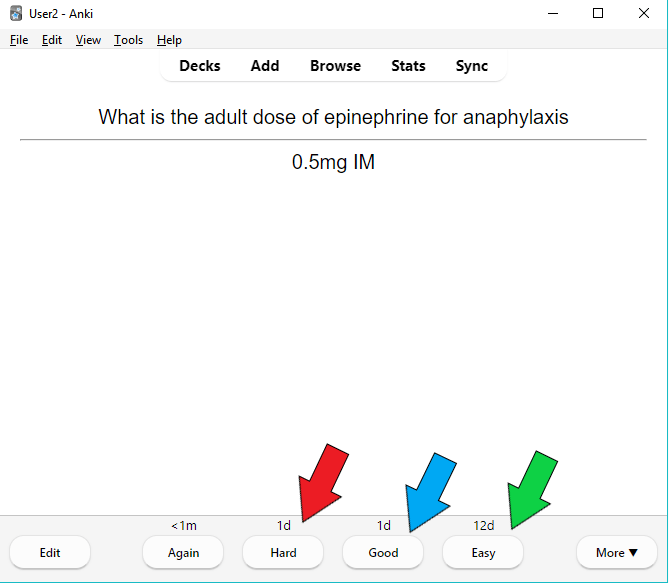
Front: What is the adult dose of epinephrine for anaphylaxis?
Back: 0.5 mg IM
Front: Name 3 symptoms of left-sided heart failure.
Back: Crackles, orthopnea, paroxysmal nocturnal dyspnea
Front: What is Beck’s Triad?
Back: Hypotension, JVD, muffled heart sounds (cardiac tamponade)
You can even use image occlusion (hiding parts of a diagram) to label anatomy or protocols.
How to Use Anki Effectively
Step 1: Make Cards from What You Learn
Every time something surprises you in lab, shows up in a lecture, or challenges your memory—make a card.
Example:
- Scenario: Chest pain patient receives ASA
- Card: “What is the PCP dose of ASA for suspected MI?” → “160–162 mg PO, chewed”
Step 2: Tag or Categorize Your Cards
Group by topic:
- Airway
- Cardiac
- Medications
- OSCEs
- Directives
This helps when you want to review only a specific area (like before an airway scenario day).
Step 3: Review Daily (Just 5–10 Minutes)
Anki works best when used consistently:
- Do your reviews every day
- Don’t worry about adding dozens of new cards at once
- Add 1–3 good cards per day based on what you learned that day
- Don’t mark a card “Easy” unless you could explain it to a classmate without pausing.
Real-Life Example
After a respiratory lab, you learned the importance of recognizing early signs of pulmonary embolism:
- Card 1: “Classic triad of PE?” → “Dyspnea, pleuritic chest pain, hemoptysis”
- Card 2: “O2 saturation in PE?” → “Often low despite clear lungs”
- Card 3: “What condition mimics PE but shows wheezes?” → “Asthma”
You now have three sharp recall tools that will resurface for you automatically until they’re locked into memory.
Tips for Paramedic Students Using Anki
- Focus on high-yield content (drugs, directives, red flags)
- Test application when possible (not just memorization)
- Use scenario experiences to generate real-world cards
- Be consistent—not perfect
Final Thoughts
Anki isn’t a crutch—it’s a memory gym. With just a few minutes each day, you can build a durable knowledge base that supports faster recall, safer practice, and stronger clinical confidence.
Combined with your smart notes in Obsidian and your reflection habits, this tool makes you retention-proof.
I. Learning Foundations
Build a strong system for thinking, studying, and remembering in high-pressure fields.
- Introduction: What This Guide Is and How to Use It
Overview of how to use VitalNotes as a toolset, not just a blog. Lays the groundwork for applying what you learn. - Learning How To Learn: Build Your Second Brain
Introduces the philosophy of externalizing your thinking and memory into a “second brain” using tools like Obsidian, Anki, and ChatGPT. - Anki for Clinical Recall
How to use Anki’s spaced repetition model to remember critical information like drugs, directives, and differentials. - Smart Notes with Obsidian
Learn to use Obsidian for linked thinking, case comparisons, and long-term concept retention with smart note strategies. - Using ChatGPT as a Study Tool
Prompts and strategies for using ChatGPT to simulate cases, quiz yourself, or clarify confusing concepts on demand. - The Pomodoro Technique for Paramedic Learning
Learn how to stay focused and avoid burnout using short, structured study blocks.
II. Practical Application
Move from theory to field-ready practice. These tools help bridge simulation, lab, and real calls.
- Scenario Days – Make Learning Stick
How to get more from scenario practice using repetition, debriefs, and learning loops. Turn repetition into retention. - Mastering Directive Decision-Making
A breakdown of how to use directives in real-time, with pattern recognition, logic triggers, and threshold thinking. - Reflecting Without Journaling
Not everyone journals—this guide offers quick, low-resistance alternatives to build metacognition through regular reflection. - Lab Integration Guide
Use lab sessions to build decision-making habits, not just check off skills. Includes scenario prep, debriefing, and error capture.
III. Clinical Reasoning
Develop clarity under pressure. These pages train your diagnostic eye, pattern sense, and mental workflow.
- Building a Clinical Mindset
Helps shift from passive protocol use to active clinical judgment. Includes strategies to slow your thinking and challenge assumptions. - Fast Pattern Recognition Builders
Drills and exercises to sharpen clinical intuition by contrasting similar presentations and exploring symptom variation. - Common Errors and How to Learn From Them
Lists the most frequent mistakes in labs and scenarios—then shows how to learn from each and correct your thinking path. - The Five Whys: A Simple Method for Better Clinical Thinking
Teaches the “Five Whys” method for exploring errors, confusing presentations, or misunderstood treatments in depth.
IV. Resources
Your support tools: guides, summaries, templates, and setup walkthroughs.
- Summary
Recap of the big ideas behind VitalNotes: learn reflectively, study actively, and build a system that supports decision-making under pressure. - Helpful Resources
Downloadables and quick-reference tools: directive cue sheets, Anki decks, debrief templates, and scenario aids. - Anki Setup & Use Guide
Step-by-step instructions for downloading, customizing, and optimizing Anki for long-term retention. - Obsidian Setup & Use Guide
How to build a clinical note vault in Obsidian: folder structures, templates, and linking strategies. - Sources and References
A list of research and literature that supports the methods taught in the blog, with commentary on their application to clinical learning.
 VitalNotes